


Multi-region strategies require careful planning around data, compliance, and operational complexity. The reasons organisations reach for multi-region are usually one of three: resilience against a full regional outage, lower latency for geographically distributed users, or a legal requirement to keep certain data within a specific jurisdiction. Each of these points toward a different architecture, and conflating them is where most multi-region projects go wrong before a single server is provisioned.
Multi-region deployment means choosing between active-passive (simpler, cheaper, accepts failover downtime — AWS's Well-Architected Framework further breaks this into pilot light and warm standby variants) and active-active (serves traffic from multiple regions simultaneously, but forces a real trade-off between data consistency and availability during network partitions, per the CAP theorem). Azure and AWS both document this same active-active/active-passive choice under their own reliability guidance and reference architectures. For EU-serving organisations, cross-border data transfer under GDPR requires either an adequacy decision covering the destination country or an alternative safeguard such as Standard Contractual Clauses — this is a legal question that should shape the architecture, not an afterthought applied once the region topology is already built.
Key Takeaways
- Active-passive and active-active solve different problems at very different cost. Active-passive accepts some downtime during failover in exchange for much lower operational complexity; active-active avoids that downtime but requires solving data consistency across regions continuously, not just during an incident.
- "Active-passive" isn't one design — it's a spectrum. AWS's Well-Architected Reliability Pillar names two specific points on it, pilot light (data replicated, compute scaled to near-zero) and warm standby (a smaller but running copy of the full stack), each trading cost against recovery speed (AWS Well-Architected Framework).
- The CAP theorem isn't a theoretical footnote here — it's the actual trade-off you're making. In the presence of a network partition between regions, an active-active system must choose between consistency and availability; most production systems choose availability and accept eventual consistency with an explicit conflict-resolution strategy.
- "Last writer wins" is a named, documented default, not just a rule of thumb. Amazon DynamoDB Global Tables uses last-writer-wins conflict resolution by default for concurrent cross-region writes to the same item — simple to reason about, but it will silently discard a legitimate concurrent update unless the application is designed to avoid or handle that case (AWS documentation).
- GDPR governs whether personal data can be replicated to a given region at all. An adequacy decision under Article 45 permits transfer without further safeguards; the European Commission has recognised a list of countries as adequate — including Japan, Canada, Switzerland, New Zealand, and, following a 2026 mutual adequacy decision, Brazil — and transfers to non-adequate countries require an alternative legal mechanism such as Standard Contractual Clauses (European Commission — Adequacy decisions).
- Multi-region for latency and multi-region for resilience are not the same project. Reducing user-facing latency needs regions positioned near users with locally-served reads; resilience needs a failover or active-active strategy that survives losing an entire region, which is a different (and usually more expensive) design goal.
Why Are You Actually Going Multi-Region?
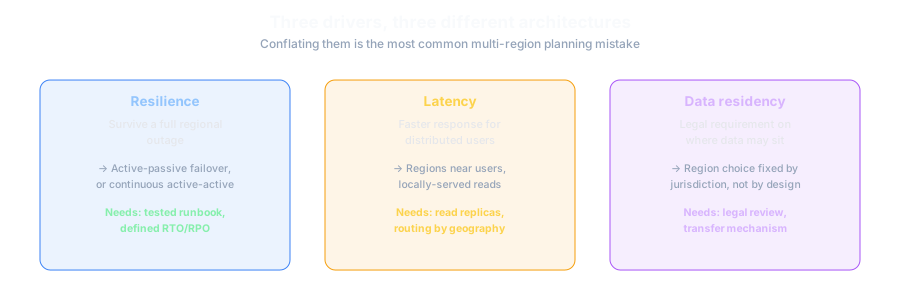
| Driver | What it actually requires |
|---|---|
| Resilience against a full regional outage | A failover strategy (active-passive) or continuous multi-region serving (active-active) with a tested recovery process |
| Lower latency for global users | Regions positioned near user populations, with reads served locally rather than round-tripping to a single primary region |
| Data residency / regulatory requirement | A specific legal determination of where data may be stored and processed, which shapes region choice independent of latency or resilience goals |
These drivers often get bundled into a single "let's go multi-region" initiative, but they lead to different architectures and different costs. A resilience-driven active-passive setup with an hour of acceptable failover time looks nothing like a latency-driven active-active setup serving writes from five regions simultaneously — and a data-residency requirement can conflict with either if it dictates that certain data must never leave a specific jurisdiction, regardless of what would otherwise be architecturally convenient.
Active-Passive vs. Active-Active
Active-passive is a spectrum, not one design
One region serves all production traffic; one or more standby regions hold a replica of the data and application stack, ready to be promoted if the primary region fails. AWS's Well-Architected Reliability Pillar is explicit that this isn't a single pattern: it names pilot light (only core data is continuously replicated, with compute scaled down to near zero until needed) and warm standby (a smaller-scale but fully running copy of the stack, ready to scale up quickly) as two distinct points on a cost-versus-recovery-speed trade-off, alongside a fuller standby that mirrors production more closely (AWS Well-Architected Framework). Microsoft's Azure Well-Architected Framework documents the equivalent active-passive pattern for disaster recovery, built on asynchronous or synchronous replication between a primary and one or more secondary regions, and is explicit about the same underlying trade-off: synchronous replication avoids data loss but adds latency, while asynchronous replication is faster but risks losing in-flight writes if the primary fails before they replicate (Microsoft Learn).
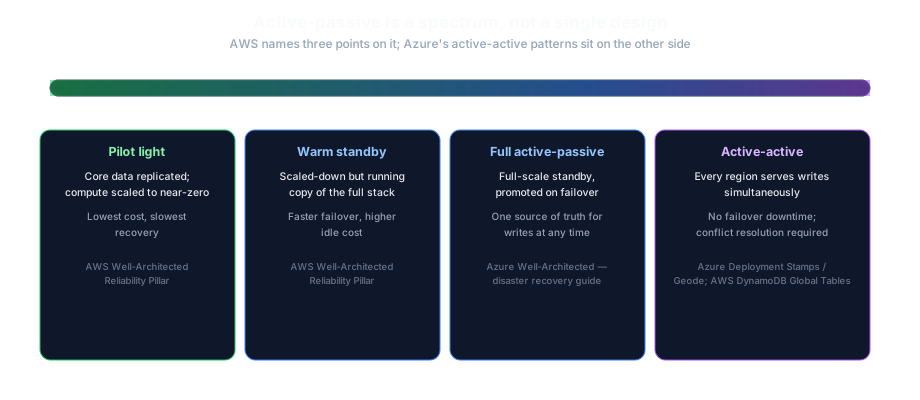
In every case, the cost of active-passive is failover time: promoting a standby region, redirecting traffic, and validating the new primary is healthy takes real time, during which the application is degraded or unavailable, and the acceptable length of that window is a business decision, not a technical one. AWS's own guidance also flags a subtler risk worth calling out directly: creating dependencies where a component in one region relies on a service in another region increases the risk that a regional failure cascades instead of staying contained — the standby region needs to actually be independently operable, not just present.
Active-active
Multiple regions serve production traffic simultaneously, including writes. This removes the failover-downtime problem for a single region's outage, but introduces a harder problem: since a network partition between regions can and will occur, the system must decide, per the CAP theorem, whether to prioritize consistency (refuse writes it can't confirm are consistent everywhere) or availability (accept writes in each region and reconcile afterward).
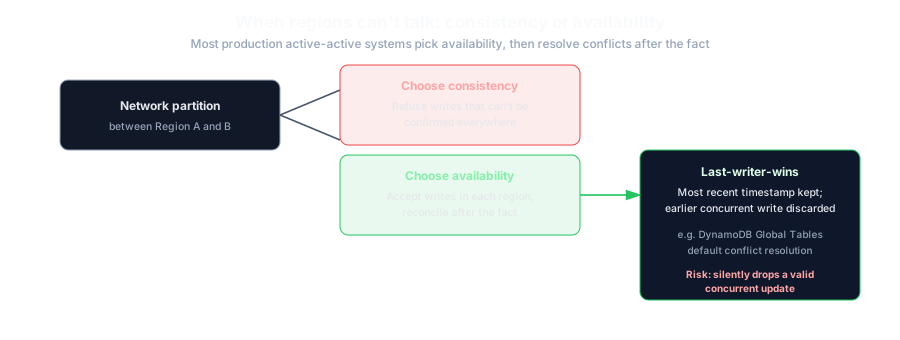
Most production active-active systems choose availability and accept eventual consistency, using an explicit conflict-resolution strategy. Amazon DynamoDB Global Tables is a concrete, documented example: it uses last-writer-wins conflict resolution by default, where the most recently timestamped write is kept and earlier concurrent writes to the same item are discarded (AWS documentation). This is a real design trade-off, not a "solved problem" — AWS's own documentation recommends architecting to avoid simultaneous writes to the same item from multiple regions, or implementing application-level conflict handling, precisely because last-writer-wins can silently discard a legitimate concurrent update. On Azure, the equivalent active-active patterns are the Deployment Stamps and Geode reference architectures, which deploy independent, regionally-distributed copies of the solution rather than a single globally-consistent database, pushing the same consistency decision into the application design (Microsoft Learn).
Active-active designs also generally avoid synchronous cross-region calls — a request in one region shouldn't block waiting for a round-trip to another region — which pushes toward locally-served reads backed by replicated data, and UI patterns that tolerate replication lag gracefully rather than assuming instant global consistency.
Data Residency, Sovereignty, and Cross-Border Transfer
For organisations processing personal data of EU individuals, region choice is not purely a technical or cost decision. Under GDPR, personal data can be transferred to a non-EU country without further safeguards only where the European Commission has issued an adequacy decision for that country under Article 45, confirming its data protection framework is considered adequate; the Commission has recognised a specific list of countries and territories, including Japan, Canada, Switzerland, New Zealand, and — following a mutual adequacy decision reached with Brazil in early 2026 — Brazil, each following a formal process involving a European Data Protection Board opinion and member-state approval (European Commission — Adequacy decisions). Where no adequacy decision covers the destination country, organisations need an alternative transfer mechanism — most commonly Standard Contractual Clauses — to lawfully transfer personal data there.
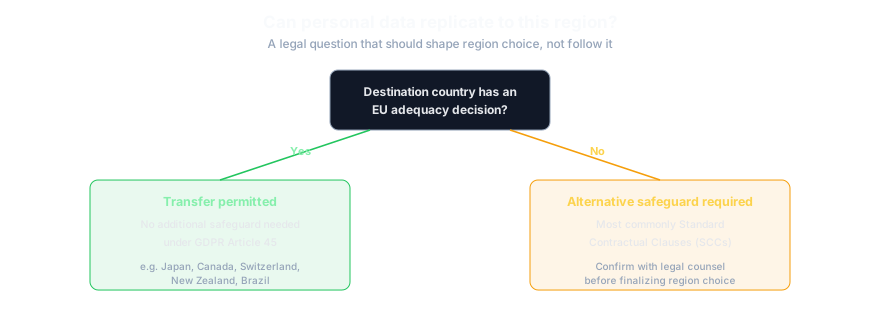
Whether a specific transfer is lawful, and which mechanism applies, depends on the destination country, the nature of the data, and current adequacy status (which can change — the Commission periodically reviews and can withdraw decisions). This section describes the published framework, not legal advice; confirm applicability with qualified legal counsel before finalizing region choices that involve personal data.
This is precisely the distinction covered in more depth in our companion article on sovereign cloud in Europe: data residency (where data physically sits) is a necessary but not sufficient condition — the legal basis for processing and transferring that data matters just as much as which region hosts it.
Common Mistakes
- Choosing active-active because it "sounds more resilient," without a clear read on the conflict-resolution cost. Active-active only pays off if the team has genuinely accepted and designed for eventual consistency; bolted on without that discipline, it produces subtle data-correctness bugs that are worse than the downtime active-passive would have accepted honestly.
- Treating "active-passive" as a single design instead of a cost/speed spectrum. Defaulting to a full warm-standby replica when a pilot-light configuration would meet the actual recovery objective wastes ongoing spend; defaulting to pilot light when the business needs minutes, not hours, of recovery time under-delivers.
- Assuming multi-region automatically satisfies data residency requirements. Deploying infrastructure in a given region doesn't by itself resolve which country's data protection law governs the data, or whether cross-region replication itself constitutes an international transfer that needs its own legal basis.
- Never testing failover. An active-passive architecture that has never had its standby region actually promoted to primary in a drill is an untested assumption, not a resilience plan.
- Creating cross-region runtime dependencies. AWS's own reliability guidance warns that a component in one region depending on a service in another region increases the chance a regional failure cascades — each region's deployment should be able to run independently.
- Underestimating replication lag's user-facing impact. "Eventual consistency" sounds abstract until a user's own write appears to vanish because they were redirected to a region that hasn't caught up yet — UX needs to account for this explicitly, not assume it away.
Trade-offs and Decision Guidance
Your business can tolerate a defined failover window (minutes to low hours, depending on your SLA), and you want disaster recovery without taking on continuous multi-region write consistency problems. Start from pilot light or warm standby and only move toward a fuller replica if the recovery-time objective genuinely requires it.
Users are genuinely global and latency to a single region is unacceptable, or your availability requirements truly cannot tolerate any failover window — and your team has the engineering capacity to own conflict resolution and eventual consistency as an ongoing operational reality, not a one-time design decision.
Cost, Complexity and Timeline
Active-passive multi-region is moderate implementation effort — standing up a replicated standby environment (pilot light, warm standby, or a fuller replica, depending on the recovery-time objective) and a tested failover runbook — with the ongoing cost being periodic failover drills and keeping the standby region's configuration from drifting out of sync with production. Active-active is significant implementation effort and ongoing operational complexity, since conflict resolution, replication lag handling, and cross-region testing are continuous engineering concerns, not a one-time setup task. Confirming and implementing data residency and cross-border transfer compliance is effort that scales with regulatory exposure — a single-jurisdiction business has a simpler task than one handling personal data across multiple non-adequate countries — and should involve legal counsel early enough to influence region selection, not after infrastructure decisions are already locked in.
Security and Governance Considerations
Multi-region architectures multiply the surface area for access control and monitoring — the same identity and access management discipline (see our cloud IAM article) needs to apply consistently across every region, not just the original primary. Replication channels between regions are themselves a security boundary that needs encryption in transit and clear ownership; a misconfigured replication link is a plausible data-exfiltration or compliance-violation path that's easy to overlook because it doesn't look like a traditional external-facing endpoint.
How Halden Solutions Approaches This
We start by separating the actual driver — resilience, latency, or data residency — before recommending an architecture, because each points to a meaningfully different design and cost profile, and conflating them tends to produce an over-engineered (or under-protective) result. On Azure, that usually means starting from the Well-Architected disaster recovery guidance and picking a replication strategy sized to the actual recovery-time objective, rather than defaulting to the most resilient (and most expensive) option available. Where personal data and EU regulatory exposure are involved, we treat the cross-border transfer question as a legal determination to resolve early, in parallel with the technical design, rather than a compliance checkbox addressed after the architecture is already built.
Frequently Asked Questions
Is active-active always better than active-passive? No — it solves a specific problem (avoiding failover downtime for a single-region outage or serving genuinely global users with low latency) at the cost of ongoing data consistency engineering. Many organisations are well served by active-passive's simplicity and lower operational burden — and "active-passive" itself spans a range from low-cost pilot light to a fuller, faster-recovering warm standby.
Does deploying in multiple EU regions solve GDPR data residency requirements? Not automatically — it depends on which regions, what data, and whether replication or processing outside the EU is involved. Data residency and the legal basis for any cross-border transfer are separate questions from simply choosing a cloud region.
What does "eventual consistency" mean in practice for users? It means a write made in one region may take some time to become visible in another region. Depending on your conflict-resolution strategy (Amazon DynamoDB Global Tables' default is last-writer-wins), a user's own recent action might briefly appear "missing" if they're served from a region that hasn't caught up yet — this needs explicit UX handling, not just backend tolerance.
How do we choose which regions to deploy in? Start from the driver (resilience, latency, or residency), then map it to actual user geography and, where personal data is involved, confirmed legal requirements — rather than defaulting to whichever regions a cloud provider highlights as most popular.
Conclusion
A sound multi-region strategy starts by being explicit about why you're going multi-region at all — resilience, latency, or data residency each point to a different architecture and a different cost. Active-passive and active-active are not a simple "better/worse" choice; they trade failover downtime against ongoing consistency engineering, and the right answer depends on what your business can actually tolerate — with both Azure and AWS documenting named variants worth choosing deliberately rather than defaulting to the most familiar one. Where personal data crosses borders, GDPR's transfer rules should shape region selection from the start, not get bolted on after the infrastructure is already live.
If you're scoping a multi-region architecture and want to make sure the design matches the actual driver — resilience, latency, or compliance — Halden Solutions' Cloud & Platform Engineering team can help work through the trade-offs for your specific requirements.
Sources
- European Commission — "Adequacy decisions"
- AWS Well-Architected Framework — Reliability Pillar, "Deploy the workload to multiple locations"
- AWS documentation — "Global tables: multi-Region replication" (Amazon DynamoDB)
- Microsoft Learn — "Recommendations for using availability zones and regions" (Azure Well-Architected Framework)
- Microsoft Learn — "Develop a disaster recovery plan for multi-region deployments" (Azure Well-Architected Framework)