


Many AI pilots fail for reasons that have nothing to do with the model. The gaps are usually in data quality, integration, ownership, and security.
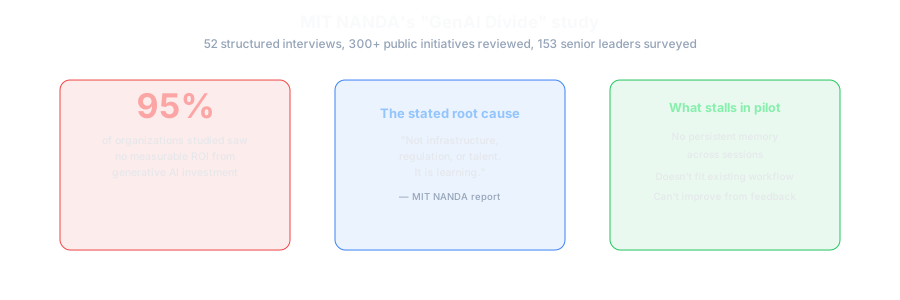
Research from MIT's NANDA initiative, based on structured interviews with 52 organizations, a review of over 300 public AI initiatives, and a survey of 153 senior leaders, found that 95% of organizations were seeing no measurable return from their generative AI investments — and explicitly identified the core barrier as organizational and workflow "learning," not model quality, infrastructure, or regulation. Gartner's separate analysis of GenAI project abandonment points to similar root causes: unclear business value, unready data, underestimated total cost of ownership, responsible-AI controls treated as an afterthought, and weak change management. Moving a pilot to production means addressing these specifically, not simply scaling up whatever worked in the demo.
Key Takeaways
- The dominant research finding is that the failure mode is organizational, not technical. MIT NANDA's report explicitly states "the core barrier to scaling is not infrastructure, regulation, or talent. It is learning" — meaning tools that don't retain context, adapt to existing workflows, or improve from feedback stall out regardless of underlying model quality.
- Gartner separately reports at least 50% of generative AI projects were abandoned after proof of concept, citing poor data quality, inadequate risk controls, escalating costs, and unclear business value as the recurring causes.
- Per-token cost at pilot scale does not predict total cost of ownership at production scale. Gartner specifically flags this gap — a cost structure that looked fine for a small pilot group can become what it calls a "budget black hole" once multiplied across a real production user base.
- Data readiness is a recurring failure point across both bodies of research, not a one-time checklist item — poor data quality shows up repeatedly as a root cause of unreliable outputs, particularly in retrieval-augmented generation implementations.
- Change management determines adoption even when the tool works. Gartner notes that technically sound tools still see usage decline over time when employees experience the rollout as a threat rather than something that empowers their work.
- Organizations that get the fundamentals right move roughly twice as fast. Gartner's analysis found organizations mastering data readiness, cost modeling, governance, and change management turn pilots into production at roughly double the rate of those that don't.
What the Research Actually Shows
MIT NANDA: the "GenAI Divide"
MIT's NANDA initiative studied generative AI adoption over the first half of 2025 through structured interviews with 52 organizations, a systematic review of more than 300 publicly disclosed AI initiatives, and a survey of 153 senior leaders gathered across four industry conferences. Its headline finding: 95% of organizations studied were seeing no measurable return on their generative AI investment. Critically, the report explicitly rules out the explanations many teams reach for first — model capability, regulatory friction, talent shortages — and instead identifies an organizational "learning gap" as the actual barrier: tools that lack persistent memory across sessions, don't integrate into existing workflows, and can't improve from user feedback stall out in pilot, regardless of how capable the underlying model is.
Gartner: five specific failure points
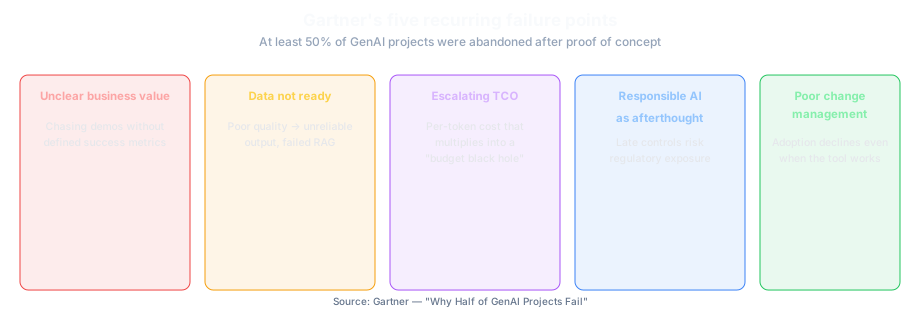
Gartner's separate analysis reports that at least 50% of generative AI projects were abandoned after proof of concept, and identifies five recurring, specific causes: unclear business value (chasing demos without defined success metrics), data that isn't actually ready (poor quality producing unreliable outputs, particularly in RAG implementations), escalating total cost of ownership (per-token costs that looked reasonable in a small pilot becoming unsustainable at production scale across thousands of users), responsible AI treated as an afterthought (safety, privacy, and fairness controls bolted on late, risking regulatory or reputational damage), and poor change management (technically working tools that still see adoption decline because the rollout wasn't managed as an organizational change, not just a technical deployment) (Gartner — "Why Half of GenAI Projects Fail").
These two independent bodies of research point in the same direction: the gap between a working pilot and a production system that actually delivers value is mostly organizational and operational, not a matter of picking a better model.
What Production Needs
Production AI needs a stable use case, a reliable data foundation, clear controls, monitoring, and a plan for what happens when the system is uncertain or wrong.

- Use-case clarity — a specific, bounded problem with a defined success metric, not "AI everywhere" deployed simultaneously across departments.
- Data and integration readiness — verified data quality feeding the system, and genuine integration into the workflow people already use, not a separate tool competing for their attention.
- Evaluation and fallback behaviour — a system that knows what it doesn't know and escalates appropriately, rather than confidently guessing. See our guide to evaluating LLMs for production use for how to build this measurably rather than by impression.
The Gap Between Pilot and Production
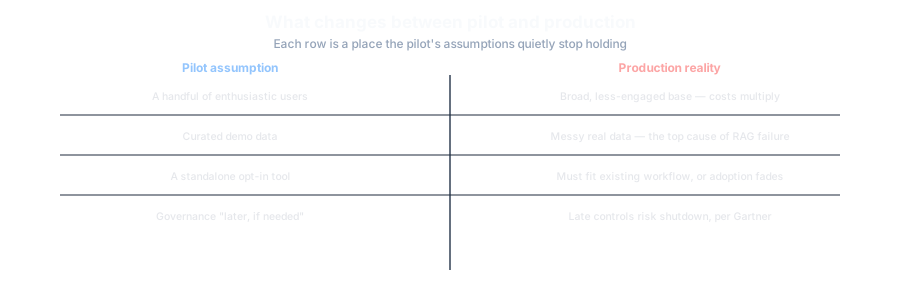
| Pilot assumption | Production reality |
|---|---|
| A handful of enthusiastic early users | Broad, less-engaged user base where per-token costs multiply into a real budget line |
| Curated demo data | Messy, inconsistent real data — the recurring root cause of unreliable RAG output Gartner identifies |
| A standalone tool users opt into | A system that must integrate into existing workflow or lose adoption over time |
| Safety/governance addressed "later, if needed" | Responsible AI controls that, if bolted on late, risk regulatory exposure or reputational damage per Gartner's analysis |
Common Mistakes
Gartner explicitly flags per-token cost as a total-cost-of-ownership risk that only becomes visible once usage multiplies across a real production population.
Data quality issues that didn't surface in a small, hand-picked pilot dataset routinely surface once the system runs against the organisation's actual, messier data.
MIT NANDA and Gartner both point to unclear business value and unfocused rollout ("deploy GenAI everywhere simultaneously") as a recurring failure driver, not a lack of ambition.
Gartner frames this as a leading cause of shutdowns, not a rare edge case.
Technical functionality is necessary but not sufficient — both bodies of research point to organizational adoption dynamics, not model capability, as the actual bottleneck for most stalled projects.
The Practical Approach
The right question is not whether AI can do the task in a demo. It is whether the organisation can operate it safely and improve it over time — which means the system needs to retain useful context, fit into the workflow people already use, and have a clear owner watching both its cost and its failure modes as usage scales past the pilot group.
Cost, Complexity and Timeline
Moving from a working pilot to a production system that holds up under real usage is consistently underestimated in both cost and timeline, largely because the research above shows the harder work — data quality remediation, workflow integration, governance controls, change management — sits outside what a pilot typically needs to demonstrate. Per-token or per-seat cost that looked negligible in a small pilot should be modeled explicitly against expected production usage before committing to a rollout timeline, rather than assumed to scale linearly and safely.
Security and Governance Considerations
Gartner's research specifically names "responsible AI as an afterthought" — safety, privacy, and fairness controls added late — as a driver of project shutdowns, not a theoretical risk. Building these in from the pilot stage, even in a lightweight form, is meaningfully cheaper than retrofitting them once a production incident or regulatory question forces the issue. Continuous evaluation and observability — tracking groundedness, relevance, and failure rate on live traffic, not just at a pre-launch gate — is part of this, not a separate later concern (Microsoft Learn — Observability in Generative AI).
How Halden Solutions Approaches This
We treat the pilot-to-production gap as the actual project, not a formality after the "real" work of building the pilot is done. That means validating data quality against real production data (not the pilot's curated set) before committing to a rollout, modeling total cost of ownership against expected production usage rather than pilot-scale token costs, and building governance, evaluation, and fallback behaviour in from the start rather than as a late addition — directly addressing the organizational and workflow gaps both MIT NANDA's and Gartner's research identify as the dominant failure mode, rather than assuming a better model is the fix.
Frequently Asked Questions
Research from MIT NANDA and Gartner both point to organizational and operational causes — data readiness, workflow integration, cost structure at scale, governance, and change management — rather than model capability as the dominant reason pilots stall.
Usually not, according to this research — MIT NANDA's report explicitly states model quality is not the core barrier to scaling; the gap is organizational learning and workflow fit.
There's no universal multiplier, but Gartner specifically warns that per-token costs which look reasonable in a small pilot can become a much larger total cost of ownership once usage scales to a full production user base — this should be modeled explicitly rather than assumed proportional.
As early as practical. Gartner identifies late-added responsible AI controls as a driver of project shutdowns; building them in from the start, even in lightweight form, is generally cheaper than retrofitting them after an incident.
Gartner's analysis found organizations that master data readiness, realistic cost modeling, governance, and change management turn pilots into production at roughly twice the rate of those that don't — treating these as upfront investment rather than later cleanup pays off in speed, not just risk reduction.
Conclusion
The gap between an AI pilot and a production system that delivers real value is, according to the research available, mostly organizational rather than technical: data readiness, workflow integration, realistic cost modeling, governance built in early, and genuine change management. Treating the pilot as proof the technology works, and production as simply "scaling it up," is exactly the assumption this research shows leads most projects to stall.
If you're planning the move from an AI pilot to a production deployment, Halden Solutions' Data & AI team can help assess the specific gaps most likely to stall your rollout before they do. See also our guide to evaluating LLMs for production use.