


The value of a voice agent is not that it sounds impressive. The value is that it can reduce repetitive first-line work while staying honest about what it knows and what it does not know. That makes use-case selection more important than the model choice — and it makes the platform's escalation and guardrail behavior at least as important as how natural the voice sounds.
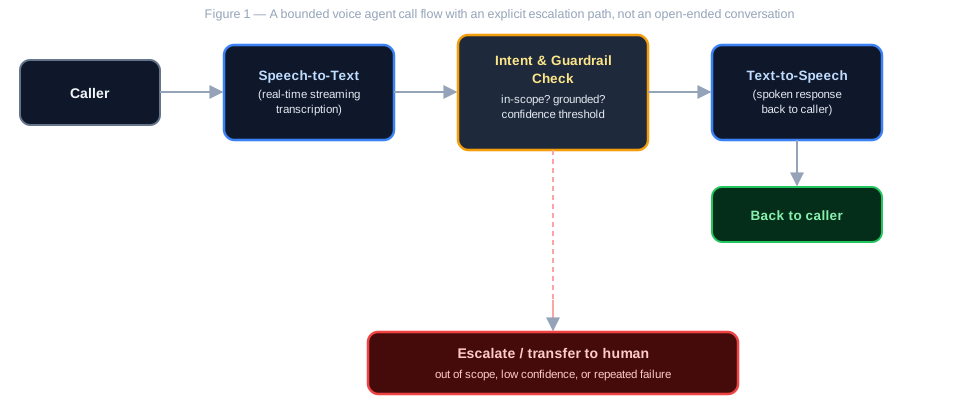
Voice agents work best on bounded, first-line tasks — reception, booking, routing, common service questions — not open-ended conversation. All three major clouds now offer managed real-time voice platforms: Azure AI Foundry's Voice Live API unifies speech recognition, a language model, and text-to-speech into one low-latency interface; AWS's Amazon Q in Connect adds generative self-service to Amazon Connect with context-preserving handoff to a human agent; and Google's Dialogflow CX publishes specific, numeric best practices for when to escalate — a maximum of three failed recognition attempts per conversation turn before routing to a human. The platform matters less than whether your team actually designs an explicit escalation path and tests it.
Key Takeaways
- Scope, not sophistication, determines whether a voice agent succeeds. The strongest deployments are specific and bounded: appointment booking, call routing, answering common service questions — not general-purpose conversation.
- Azure, AWS, and Google Cloud have each shipped a mature, managed real-time voice stack, which means most organizations no longer need to hand-assemble speech-to-text, an LLM, and text-to-speech themselves.
- Escalation isn't a vague principle — Google publishes an actual number. Dialogflow CX's own design guidance recommends a maximum of three no-match or no-input events per conversation page before routing to a human agent (Google Cloud documentation).
- Context preservation on handoff is a named, specific capability, not an assumption. AWS's Amazon Q in Connect explicitly preserves full conversation context when transferring a customer from self-service to a human agent (AWS) — a detail worth confirming on any platform you build on, since a "successful" escalation that loses context just makes the caller repeat themselves.
- A voice agent should never invent company facts or pretend it can do more than the system behind it allows. Good design puts guardrails, grounding, and a defined escalation path in place from the start, not as a post-launch fix.
Good Use Cases
The strongest applications are specific and bounded: appointment booking, routing callers, answering common service questions, or guiding a caller to the right part of a process.
- Reception and call handling.
- Lead qualification and booking.
- Internal support and workflow routing.
How the Major Cloud Platforms Approach Real-Time Voice
Halden Solutions builds voice agent deployments primarily on Microsoft Azure; where a client's broader AI stack sits on AWS or Google Cloud, both remain strong options for this specific capability, since real-time voice AI is an area all three providers have invested in heavily.
Azure AI Foundry: Voice Live API
The Voice Live API is Microsoft's fully managed, low-latency speech-to-speech interface: it consolidates speech recognition (140+ locales), a choice of generative models (including GPT-4o and GPT-realtime variants), and text-to-speech (600+ voices across 150+ locales) behind a single WebSocket connection, removing the need to manually orchestrate separate speech and language services (Microsoft Learn). It includes conversational features specifically built for voice, not just transcription — noise suppression, echo cancellation so the agent doesn't hear its own audio output, interruption handling, and end-of-turn detection for natural pauses — plus function calling so the agent can trigger real actions (a booking, a lookup) rather than only talk. Where a deployment needs telephony-level call control (answering, routing, transferring an actual phone call) rather than just the AI conversation itself, Azure Communication Services' Call Automation integrates with Azure OpenAI directly: incoming audio is transcribed via the Recognize API, sent to Azure OpenAI for a response, and played back via the Play API's text-to-speech (Microsoft Learn).
AWS: Amazon Connect and Amazon Q in Connect
Amazon Connect's generative AI layer, Amazon Q in Connect, extended to voice (IVR) self-service in December 2024. It's designed to reason over "undefined intents for more ambiguous scenarios" — handling requests a rigid decision-tree IVR couldn't — while supporting genuinely transactional tasks like booking or scheduling, not just answering questions. The specific detail worth designing around: when a call needs to hand off to a human agent, Amazon Q in Connect is built to preserve the full conversation context through that transition, so the caller isn't asked to repeat what they already said (AWS).
Google Cloud: Dialogflow CX
Google's Dialogflow CX documentation is unusually specific about voice interaction design, publishing concrete guidance rather than general principles: keep the welcome message brief and get to the first topic quickly; on a failed recognition ("no-match"), rephrase rather than repeat the same prompt verbatim; and — critically — cap no-match/no-input events at a maximum of three per conversation page before routing to a human agent (Google Cloud documentation). Google also recommends tracking specific quality metrics — misroute rate, first-call resolution, average handling time, and conversation turn count — as the operational signal for whether a deployed voice agent is actually working.
Comparison: Real-Time Voice Platforms
| Azure AI Foundry (Voice Live API) | AWS (Amazon Connect + Q in Connect) | Google Cloud (Dialogflow CX) | |
|---|---|---|---|
| Core strength | Unified speech-to-speech interface with built-in conversational handling (interruptions, turn-taking) | Generative self-service integrated into an established contact-center platform | Explicit, numeric design guidance for escalation and conversation structure |
| Context-preserving handoff | Supported via Foundry Agent Service integration | Explicitly named capability | Supported via CX session/session parameters |
| Escalation guidance | Configured per implementation | Built into Q in Connect's design | Published numeric threshold (max 3 no-match/no-input) |
| Telephony/call control | Azure Communication Services Call Automation | Native to Amazon Connect | Native via CCaaS integrations |
Sources: Microsoft Learn, Microsoft Learn, AWS, Google Cloud documentation. Verify current capabilities directly with each provider before committing to an architecture — these platforms update frequently.
The Safety Rule
A voice agent should never invent company facts or pretend it can do more than the system behind it allows. Good design puts guardrails, escalation, and booking paths in place from the beginning — the same input/output guardrail pattern covered in our companion article on AI safety guardrails applies directly here, since a voice agent is still a generative AI system with the same hallucination and prompt-injection risks, just delivered through a different modality.
Common Pitfalls to Avoid
Voice quality and conversational fluency aren't the bottleneck — reliable routing and a clear escalation path are. A simpler agent with disciplined escalation outperforms a highly fluent one that occasionally invents an answer.
If your design doesn't specify a concrete number — like Google's own "three no-match events" rule — "escalate when appropriate" tends to mean "never, until a caller hangs up frustrated."
An escalation that makes the caller repeat everything they already said isn't really a successful handoff — verify your platform's context-preservation behavior explicitly rather than assuming it.
Measuring Success
| Metric | Why it matters |
|---|---|
| Misroute rate | Directly measures whether the agent is sending callers to the right place — one of the metrics Google's own design guidance recommends tracking |
| First-call resolution | Whether the agent actually resolved the request, not just handled the call politely |
| Escalation rate | Too low can mean the agent is answering things it shouldn't be confident about; too high means it's not handling the bounded task it was built for |
| Conversation turns / average handling time | Signals whether the agent is efficiently resolving requests or looping callers through repeated clarification |
How Halden Solutions Approaches This
We start by identifying the single operational task a voice agent should own — reception, booking, or routing — rather than scoping an open-ended assistant, because the research on this consistently points to bounded use cases succeeding where general-purpose ones stall. Where a client is on Azure, we build on the Voice Live API and Azure Communication Services for telephony integration; where AWS or Google Cloud is the better fit for the client's broader stack, we build the same escalation discipline — explicit thresholds, context-preserving handoff, and guardrails against invented facts — on Amazon Connect or Dialogflow CX respectively, since the platform changes the implementation, not the underlying design discipline.
Frequently Asked Questions
What makes a good voice agent use case? Specific, bounded tasks — appointment booking, call routing, answering a defined set of service questions — rather than open-ended conversation. The narrower the scope, the more reliably the agent can stay within what it actually knows.
Which cloud platform should we build a voice agent on? This should follow your existing cloud and telephony infrastructure rather than be chosen in isolation. Azure's Voice Live API and Communication Services are a strong default if you're already on Azure; Amazon Connect or Dialogflow CX are equally capable if your contact-center infrastructure is already on AWS or Google Cloud.
When should a voice agent escalate to a human? There's no universal number, but Google's own Dialogflow CX design guidance recommends capping failed recognition attempts at three per conversation turn before routing to a human — a concrete, testable rule worth adapting rather than leaving escalation vague.
Does escalation to a human agent preserve what the caller already said? It should, and it's a capability worth verifying explicitly rather than assuming — AWS's Amazon Q in Connect names full context preservation on handoff as a specific feature, which is the behavior any platform you choose should be tested against.
Conclusion
Voice agents succeed when they're scoped to a specific operational problem, backed by a platform's real guardrail and grounding capabilities, and given an explicit, tested escalation path — not when they're judged by how natural the voice sounds. Azure, AWS, and Google Cloud have each built mature real-time voice platforms with the pieces needed to do this well; the deciding factor is whether your team actually designs the escalation threshold and verifies context handoff, rather than assuming the platform handles it.
Ready to explore AI voice agents for your operations? Halden Solutions' AI Voice Agents team can help scope the right use case and platform for your environment.
Sources
- Microsoft Learn — "Voice Live API Overview" (Azure AI Foundry)
- Microsoft Learn — "Call Automation AI Sample" (Azure Communication Services)
- AWS — "Amazon Connect launches generative AI-powered self-service with Amazon Q in Connect"
- Google Cloud Documentation — "Voice agent design best practices" (Dialogflow CX)